
Visiony LAB*
Where performance meets innovation.Where performance meets innovation.
*LAB - cognitive development laboratory
Visiony LAB
From Game to Life: Advance Your Skills
Support brain development. Cognitive training strengthens memory, logical thinking and the ability to learn quickly – ideal for children, adults and athletes.Uninterrupted concentration. The ability to ignore distractions increases performance not only on the field, but also at school or work.
Perfect eye-brain-body synchronization. Training connects visual perception and motor reactions for maximum efficiency in any situation.
Game perception on a whole new level. Improving peripheral vision will allow you to better read what is happening on the field and in everyday situations.
Reactions in a split second. Fast and precise reactions will put you one step ahead – whether it’s sports or everyday decisions.
Concentration that lasts. Learn to maintain stable attention during any task – from intensive training to a demanding exam or test.
Visiony LAB
The emergence of Visiona
The Visions project originated at the Peaches kemp floorball camp, where we take care of the development of goalkeepers. The floorball camp became a diploma thesis entitled “Design and Implementation of Cognitive Training Aids”.
The development of the aids was preceded by several years of experience in training both floorball skills and cognitive development. In this section of the website you will find several studies that show the importance of cognitive development. We have read them all for you, made a short summary and described the results. And for the more daring, we also include links to the original texts of the studies.
Visiony LAB
Cognitive processes on the field
Visiony LAB
The importance of cognitive training
Cognitive training is not only about improving performance in sports, but also about developing mental skills that are crucial for everyday life. Our Visiony Stick allows you to train reaction times, memory, concentration and other important cognitive functions that affect not only your sports results, but also your ability to respond to stimuli in stressful situations, planning, decision-making or multitasking*.
Our device is designed to make training not only effective, but also fun. With us, cognitive development becomes a pleasant and motivating challenge that will move you not only in the world of sports, but also in everyday life. Be ready to face challenges and take your skills to a new level, where fun is an integral part of progress.
*Multitasking, as we often perceive it, does not actually exist because our brains only switch between tasks quickly, which can lead to lower efficiency, which is why we focus on developing the ability to switch effectively and mental flexibility.
Studie 1
Speed of decision-making as a key element for professional and academy soccer players’ performances
A study of soccer players comparing professional athletes and U20 players, assessing the speed and quality of their decision-making in various sports performances.
The first finding was that professionals make around 2500 decisions per match per team, and U20 players make fewer decisions. More precisely, around 1500 decisions. These numbers are shown in Table 1.

The study collected data on the speed of decision-making, but also on the quality of this decision. The speed of decision-making was measured in seconds. The quality of decision-making was measured on a scale of 0 – 100, where 0 means the worst possible value of the decision.
Table 2. contains several sports tasks, which are further divided into groups. Attacking principles and defensive principles. At first glance, the table may seem confusing, but in fact it is easy to navigate.
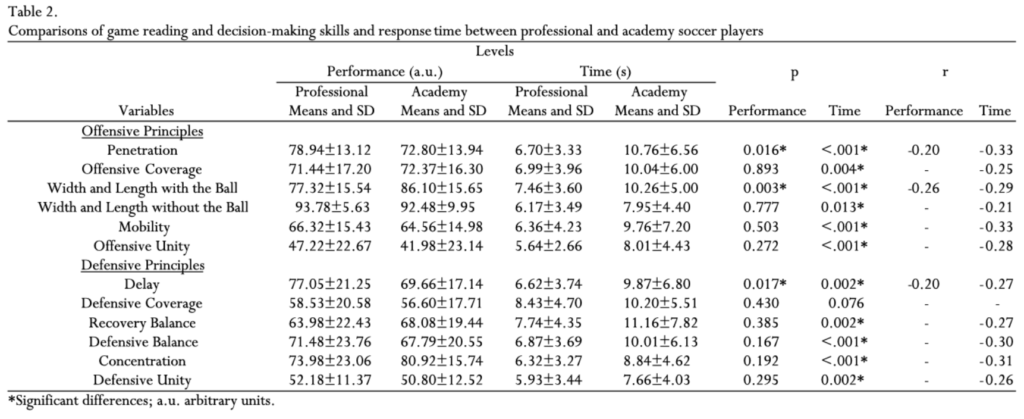
In the case of the two columns labeled Performance (a.u.), the quality of decisions of professional footballers is included in the first column and the quality of decisions of U20 players is included in the second column. The same distribution can be seen in the third and fourth columns labeled Time (s). Both of these columns include reaction time. The third column corresponds to professional footballers and the fourth column corresponds to U20 players.
When we look at the quality of decisions, we find several actions where U20 players have a higher rating than professionals. However, when we look at the comparison of the speed of these decisions, we notice that professionals are faster in each action.
Looking at the action Width and Length with/out the ball, for example, we see that U20 players have better quality decisions. However, practice in sports shows that in this case it is important to react quickly and thereby move the game forward. So if we compare it to an average professional player and an average U20 player, we see this situation. The U20 player makes a decision with the ball at 86% but his decision takes 10.26 seconds. So the game slows down and the chance of losing increases. In the case of a professional, the decision will be at 77% but the decision time will only be 7.46 seconds. This allows the game to flow and reduces the chance of losing.